
products
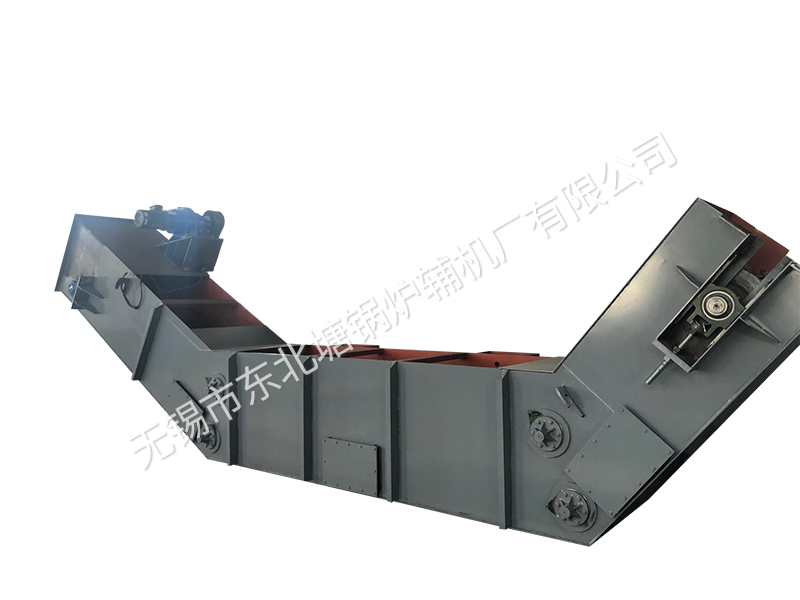
1. Purpose, Principle and Characteristics:
1. Purpose: This machine is used for slag removal in various coal-fired boilers of thermal power plants and can be matched with 25-600MW units (boilers with an evaporation capacity of 130---2000t/h). Our company can design slag extractors of different specifications and forms according to the specific requirements of customers. The slag extractor is the main equipment in boiler slag removal equipment. It forms a complete boiler slag removal system together with equipment such as slag wells (including supports), shut-off doors, slag crushers, and self-propelled movable slag buckets.
2. Working principle: The upper tank is filled with cooling water (water temperature ≤ 60℃). The high-temperature red slag in the furnace falls into the water in the upper tank through the slag well and the shut-off door for sudden cooling and granulation. It is dragged forward by the angle steel scraper pulled by the circular chain, then crushed by the slag crusher and enters the slag ditch, and is hydraulically transported to the ash slurry pool. Alternatively, it can be directly loaded into a vehicle or stored in a self-propelled movable slag bucket without going through the slag crusher, and then transported out by vehicle for comprehensive utilization.
3. Features: This machine is used in conjunction with the shutdown door. After the shutdown door is fully opened, it is inserted into the water in the upper trough to form a sealing system at the bottom of the furnace, ensuring no air leakage at the furnace bottom and stable operation of the boiler. When the slag extractor malfunctions, the shutdown door can be closed to allow slag to accumulate in the slag well, achieving the purpose of repairing the slag extractor without stopping the furnace. This machine is equipped with various monitoring and protection devices (such as chain drop protection, safety clutch overload protection, current overload protection of the electrical system, etc.) and an electric control cabinet, facilitating on-site and remote monitoring of the operating status. Compared with the hydraulic slag discharge scheme, this machine saves water, electricity and coal. It improves the operating conditions, reduces the labor intensity of operators, enhances comprehensive benefits, and ensures safe and reliable operation of the boiler.
II. Specifications and Technical Parameters:
The main specifications and technical parameters are shown in Table (1)
| Main Specifications | unit | numerical value | |
| slot width | mm | 600—2000 | |
| slag discharge capacity | rated | t/h | 5—65 |
| Max | t/h | 80 | |
| Motor power | KW | 3—22 | |
| Water consumption | t/h | 5—60 | |
| Water volume | m3 | 8—80 | |
| Water depth | mm | 1000——2500 | |
| Scraper speed | m/min | 0.3—1.2 | |
III. Installation, commissioning and trial operation:
(1) Installation:
1. Position the slag conveyor, using the center line of the slag well, the upper plane of the track, and the elevation of the slag conveyor as references. Lift it with a jack and level the slag conveyor (the flatness tolerance of the water surface ≦ 1/1000).
2. Place the walking wheel on the guide rail and weld it firmly to the vertical plate of the machine body.
3. Welding platform: The platform should be level. It is allowed to tilt slightly towards the machine body (≤5℃), but tilting outward is not allowed.
4. Water pipe installation: Water pipes, joints, etc. should be rinsed clean before installation. After installation, there should be no water leakage, and the water pressure should meet the requirements specified by the water system.
(2) Debugging:
1. After the equipment is installed, the debris in the upper and lower troughs should be thoroughly cleaned, the slag discharge hole should be closed, and no-load operation should be carried out. At this time, the following key inspections and debugging should be conducted:
1) Whether each scraper is properly connected to the chain;
2) Whether the whole machine runs smoothly and whether there is any abnormal noise;
3) Whether the motor starts and switches normally;
4) Whether the overload alarm is activated;
5) Whether the water flow sealing water channel of each guide wheel is unobstructed.
2. Parts and methods requiring debugging for this machine:
1) Tightness of the connecting chain between the reducer and the main shaft;
2) Tension device adjustment: see Figure (2)
Loosen the nut of the screw support frame of the tension device, rotate the nut of the lifting part to make the screw move upward, and tension the scraper chain. The tension degree should be such that the lower guide wheel can rotate properly, then tighten the nut of the bearing seat support frame. The adjustment amount during adjustment should be kept consistent, and the length direction of the scraper should be perpendicular to the side wall of the machine body.
During the trial operation, someone must always be on-site to observe and take records.
2. Responsible for trial operation:
First, open the water channel sealing valve of the upper guide wheel to make it unobstructed, then inject water into the upper trough of the slag extractor to the designed water level.
Start the slag crusher first, then start the slag extractor. After it operates normally, open the shut-off door to allow the ash and slag in the slag well to fall into the upper trough. Adjust the supplementary overflow water volume to keep the water temperature at around 60°C.
The load trial operation is carried out in stages.
Stage 1: Continuous operation for 8 hours. Check the tightness of the scraper chain, and adjust the tensioning wheel to make the chain properly tight (that is, the rear lower guide wheel should rotate to ensure the normal operation of the chain drop alarm).
Stage 2: Continuous operation for 24 hours. Check the tightness of the scraper chain and whether the joints are loose, and handle them in a timely manner. During the load operation in the second stage, start the slag extractor first. When the trough is full of ash and slag, close the shut-off door. After the ash and slag are dragged out of the slag extractor, open the shut-off door again to make the slag extractor operate normally.
Stage 3: Continuous operation for 40 hours. Check the following:
1) The tightness of the chain; 2) The connection status of each scraper joint; 3) The sensitivity and reliability simulation test of each alarm device; 4) The overall operation status should be stable without abnormal noise or jamming. After all aspects of the load operation are normal, put it into use.
