
products
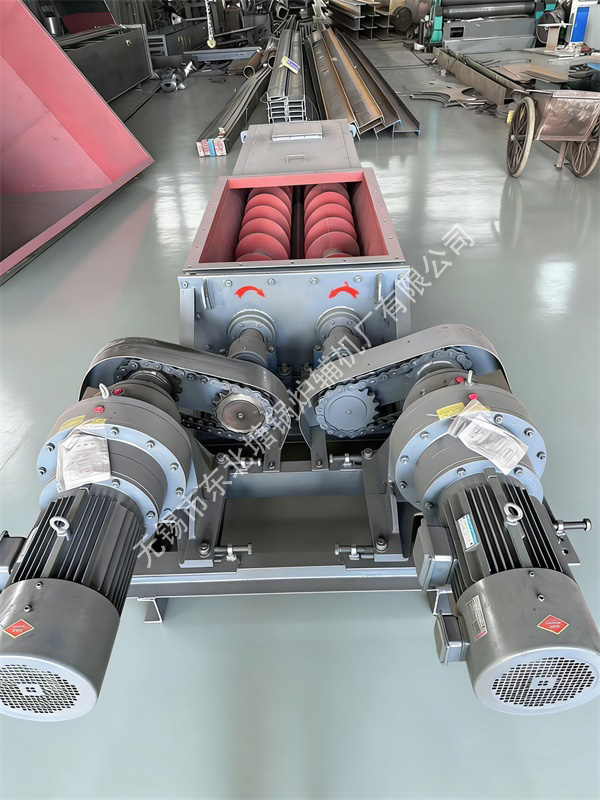
Instruction Manual for Shaft Screw Conveyor
1. Equipment Overview
The double-shaft screw conveyor is composed of a driving device, double screw shafts (one left-handed and one right-handed), a U-shaped casing, bearing blocks, a frame, seals, etc. The double shafts rotate synchronously in opposite directions, and have the functions of conveying, stirring, crushing, and anti-clogging. The conveying capacity is 1.5–2 times that of a single shaft, making it suitable for viscous, easy-to-caking, and easy-to-entangle materials.
II. Technical Parameters (General)
• Conveying capacity: 10–200 t/h (adjustable according to materials)
• Rotational speed: 37.5–53 r/min
• Single machine length: 2–12 m, can be connected in series up to 70 m
• Inclination angle: horizontal 0°, Max 35°
• Operating temperature: -20℃–120℃ (customizable)
• Motor protection: IP54/IP55, insulation class F
• Noise: ≤75 dB(A), dust leakage <10 mg/m³
III. Installation Requirements
1. Foundation: The concrete foundation shall be flat and firm, and the levelness of the frame shall be ≤1/1000
2. Connection: The screw shaft adopts embedded tongue connection, no axial movement is required, and the installation is convenient
3. Sealing: The casing cover is tightly sealed, and the bearing seat is multi-layer sealed to prevent dust infiltration
4. Drive: The coaxiality of the motor and reducer is ≤0.1 mm, and the coupling is elastically connected
5. Lubrication: After installation, apply grease/oil to all lubrication points
Fourth, Pre-startup Inspection
• The power supply and control circuits are normal, and the grounding is reliable
• No foreign objects or jamming inside the machine casing
• No loose fasteners
• The oil level of the reducer is at the middle line of the sight glass, and the bearing lubrication is sufficient
• The safety shield is in good condition
Fifth, Operation Procedure
1. No-load Test Run (Mandatory)
• Jog 2–3 times to confirm correct rotation direction and no abnormal noise
• Continuous no-load operation for 2–8 hours, check:
◦ Bearing temperature rise ≤ 40℃
◦ No leakage or abnormal noise from the reducer
◦ The whole machine runs stably with no excessive vibration
2. Load Operation
• First start the machine, then feed materials; first stop feeding, then shut down the machine (it is strictly prohibited to start with materials)
• Feed materials evenly to avoid instantaneous full load
• During operation, observe: stable current, no abnormal noise, no leakage, and smooth material conveying
• It is forbidden to operate with excessive temperature, excessive current, or excessive load
3. Shutdown
• Stop feeding, and shut down the machine after the materials in the machine are emptied
• Cut off the power supply and clean the site
Sixth, Maintenance (Core)
1. Daily (per shift)
• Check current, temperature, noise, and sealing
• Clean up accumulated materials at the feed inlet and discharge outlet
• Check fasteners
2. Weekly
• Special chain oil for chain/sprocket spraying (twice a week when there is a lot of dust)
• Fill bearings with NLGI Grade 2 lithium-based grease (-20℃–150℃)
• Inspect seals and replace aged parts
3. Monthly
• Check the wear and welds of the spiral blades
• Adjust chain tension
• Clean up residual materials in the machine casing
4. Every 500 hours (first time)/every 2000 hours (regular)
• Replace reducer gear oil (ISO VG 220/320, GL-5)
• Conduct a comprehensive inspection of bearings, seals, and couplings
• Tighten all bolts
VII. Safety Regulations
• Operators must wear goggles and anti-slip gloves. It is strictly prohibited to wear loose clothing or gloves when approaching rotating components.
• Do not open the machine casing, clean, or perform maintenance during operation.
• For maintenance, the power must be cut off, a warning sign must be posted, and a designated person must supervise.
• It is prohibited to convey flammable, explosive, or strongly corrosive materials (for non-customized models).
• In case of abnormalities, stop the machine immediately, cut off the power, and troubleshoot.
VIII. Common Faults and Troubleshooting
Fault, Cause, Handling
Difficult start-up/high current: Material accumulation or jamming inside the machine; lack of oil in bearings. Empty the material; add oil; check the coupling.
Overheating of bearings: Lack of oil, seal failure, poor coaxiality. Replenish oil; replace the seal; correct coaxiality.
Material blockage: Too fast feeding, overly sticky material, worn blades. Feed uniformly; clean; replace blades.
Abnormal noise: Poor gear meshing, damaged bearings, loose fasteners. Adjust meshing; replace bearings; tighten fasteners.
Leakage: Aging seal, loose cover plate. Replace the seal; tighten the cover plate.
IX. Scope of Application
Suitable for powdery, granular,block-shaped (bulk), and viscous materials (such as cement, fly ash, grain, sludge, chemical raw materials), and widely used in industries such as building materials, metallurgy, chemical industry, grain, and environmental protection.
